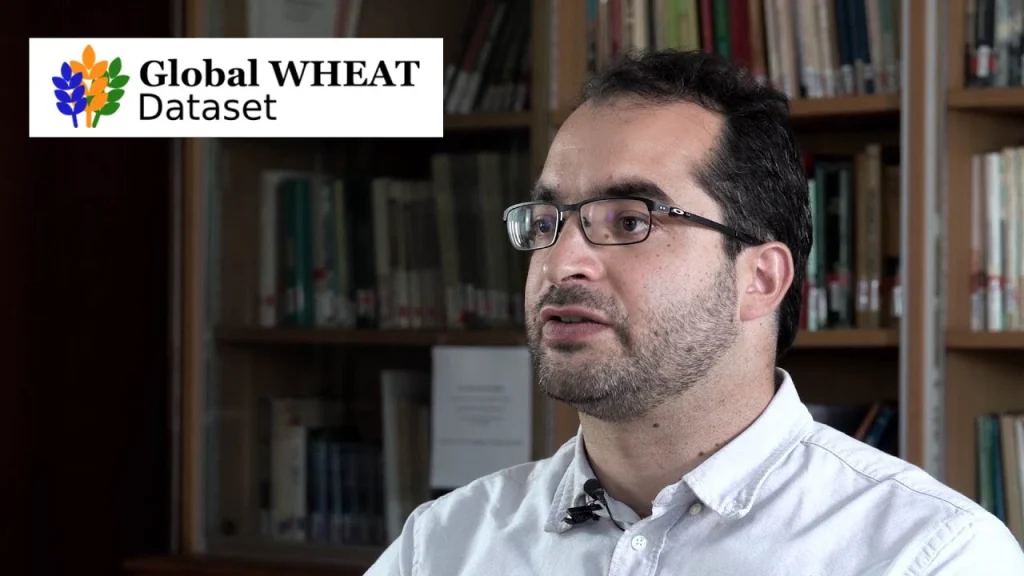
Counting wheat heads by hand is slow, tedious and error-prone. In this first episode of the Global Wheat Challenge series, the team explains why a better way was needed and how image analysis can deliver it.
Go further with the Global Wheat Head Dataset 2021 paper, the updated version of the dataset behind the competition.
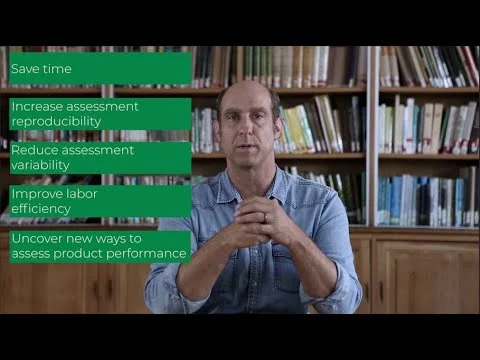
Discover in a short video Hiphen’s image analytical solutions for agriculture, and learn how they can augment your crop knowledge.
Hiphen was awarded funding through the EU DIVA program for its innovative project on High-throughput Phenotyping for Biorationals in Arable crops [HiPheBia]. The efficacy of biorationals for arable crops is difficult to establish in open field crops due to the product’s characteristics and the field assessment methodology constraints. Thanks to our partners Eurofins Agroscience Services and Certis France, this project aims at developing a prototype of an innovative, high-throughput phenotyping service to evaluate their efficacy in arable crops, especially against Fusarium on wheat.
Biorationals are crop protection products based on natural compounds, they can contribute to the sustainable intensification of agriculture. Globally, the biorational market is growing at two-digit growth and offers great perspectives. However, for arable crops, not many biorationals are registered for use and available to European farmers because the efficacy of these products is difficult to establish in open field crops, due to product characteristics and to constraints of methodology for the field researchers.
HiPheBiA- High-throughput Phenotyping for Biorationals in Arable crops- aims at developing an innovative phenotyping service dedicated to the field efficacy evaluation of biorational solutions against pests and pathogens in arable crops. Our one-stop solution will integrate new imagery data automatically processed through algorithms with other field-related agronomic and climatic information. The final outcome will be a comprehensive efficacy assessment of the biorational solution in its field context.
In this project we will first elaborate a prototype of the service for biorational field experiments against Fusarium sp in Wheat. Field experiments will be provided by our partner Eurofins Agroscience Services, a registered DIVA demonstration site and potential end-user of our solution.
With our solution, our end-users will be able to enlarge their field experiments and collect more data with a guarantee of standardization, quality and traceability. Moreover, they will be able to evaluate the global efficacy of a biorational within its agro-system, as we will integrate the complex agro-pedo-climatic interactions as well as the indirect environmental benefits of biorationals into our advanced deep learning analytics. This will improve the whole agro value chain as more biorational solutions will be available for use in arable crops, contributing to a safer and more sustainable agriculture using less chemical pesticides.
Thank you all for your interest in our solutions and to our partners for their trust. We are looking forward to presenting you the results of this project.
Keep safe.
Hiphen is proud to announce the launch of its partnership with Planet Labs, a leading satellite imagery provider with whom we are looking to enhance the range of solutions available to the agriculture sector – from plant breeders to farmers, cooperatives and agro-industrial actors.
Planet has launched satellite constellations such as PlanetScope (2009) and SkySat (2014) that today encompass more than 150 satellites in orbit that are able to image anywhere on Earth daily at 3 meter and 72 centimeter resolution. Using Planet's API and online tools, you can access 360M+ sq km of daily imagery to monitor extensive and distributed areas of interest (AOI), and analyze trends with PlanetScope and SkySat archives.
Planet believes that space can help life on earth. Today's agriculture falls into this vision and we are making change visible thanks our near daily imagery. Hiphen's applications and expertise can leverage this information into valuable insights at the speed of change. As such Hiphen has developed robust methods to deliver daily field imagery by constantly seeking means to merge satellite imagery with sensors and with the latest advancement in crop science in order to deliver always greater value to all players across the agri-sector.
Through this partnership, both companies can leverage their technology and expertise to provide a new dimension to precision agriculture applications – that so far where essentially relying on legacy methods and tools such as Sentinel-2 (with a 10 meter resolution, and a 5-days revisit frequency). While Sentinel-2 remains a valuable asset to the agriculture sector, at Hiphen we believe that the information that we can deliver with Planet is set to augment and improve these methods – adding value to many actors in the sector and opening new perspectives to academics.
On November 7th 2019, Hiphen and Planet will be hosting a webinar that we encourage you to join to hear about the advantages behind this partnership and ask any burning questions. At this event, we will notably cover some of the hot use cases that we believe will change the game, notably explaining how plant breeders can leverage the Hiphen-Planet solution to monitor field experiments, or how we can help to improve support management tools for agro-industrial actors.
We look forward to answering your questions at this webinar.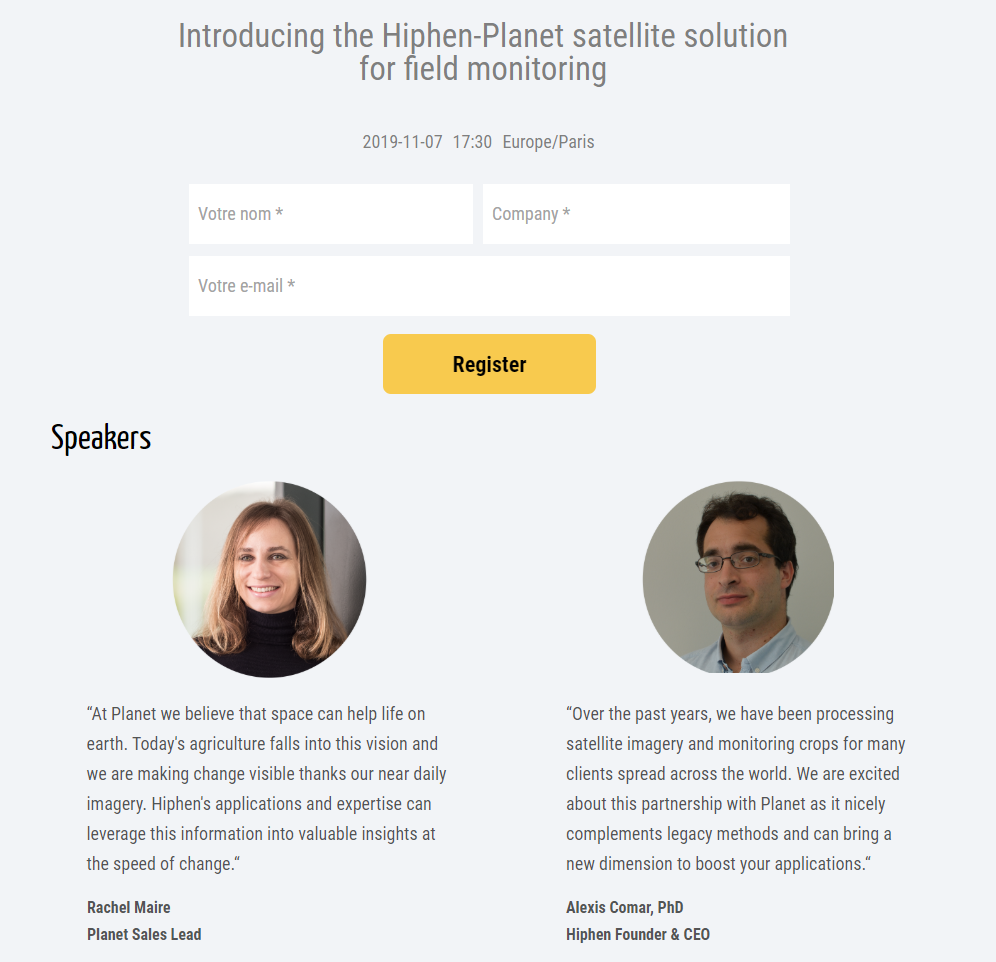

In this first episode, Alexis Comar (Hiphen Founder & CEO) asks Professor Frédéric Baret (Research Director at INRA EMMAH) about the purpose of UMT CAPTE.
UMT CAPTE is a scientific research unit based in Avignon (France) and specialised in developing methods and technologies for high-throughput plant phenotyping applications. The state-of-the-art technology and precision tools developed at UMT CAPTE help to overcome agricultural and environmental challenges faced by the actors within the agriculture industry.
The strength of this research unit lies in the close collaboration between Technical Institutes such as Arvalis, Hiphen (a privately-owned company) and the French National Institute for Agricultural Research (INRA).
Associate partners include: Terres Inovia, ITB, CTIFL, Geves and ACTA.
UMT CAPTE was created in January 2013 and is approved by the French Ministry of Agriculture and Food to develop tools and methods for an efficient use of sensors and remote sensing in agriculture.
As such, CAPTE stands for "CAPteurs (sensors) et TELedectection (remote sensing)".
To learn more about the projects led by CAPTE members, and the methods and solutions we introduced, please visit our CAPTE website or contact us at contact@hiphen-plant.com. A list of the 40+ scientific papers we published since our inception is also available in our archive.